.png?width=290&height=50&name=image_1%20(1).png "image_1 (1)")
The growing demand for joint health and mobility products has driven interest in ingredients that support connective tissue structure and function.
Bioavailable silicon has gained relevance in this category due to its association with collagen networks, extracellular matrix integrity, and tissue resilience (See Post “The Importance of Silica in Collagen Synthesis: Biochemical Mechanisms”).
LIVING SILICA® provides a stabilized, bioavailable silicon source designed for integration into joint health and connective tissue formulations.
Silicon and Connective Tissue Structure
Silicon is associated with structural components of connective tissue, particularly through its relationship with collagen and extracellular matrix organization.
From a formulation perspective, its role is linked to:
- Collagen formation and structural organization
- Maintenance of connective tissue integrity
- Support for elasticity and mechanical strength
These functions make it relevant for formulations targeting joint function, mobility, and long-term structural support.
A) Joint and Extracellular Matrix Support
Joint function depends on the integrity of cartilage and surrounding connective tissues.
Silicon is associated with processes related to:
- Formation of glycosaminoglycans (GAGs), key components of cartilage matrix
- Maintenance of joint lubrication and cushioning
- Structural support of connective tissues under mechanical stress
This positions bioavailable silicon as a complementary ingredient in formulations focused on joint comfort and mobility.
B) Cartilage Structure and Glycosaminoglycan Pathways
Cartilage is composed primarily of collagen and proteoglycans, including glycosaminoglycans such as:
- Chondroitin sulfate
- Hyaluronic acid
These molecules contribute to:
- Water retention and lubrication
- Shock absorption
- Tissue elasticity and resilience
Silicon is believed to play a supportive role in the structural environment where these components are synthesized and maintained.
While not acting as a direct enzymatic cofactor, it is associated with:
- Collagen matrix formation
- Stability of extracellular structures
- Overall cartilage integrity
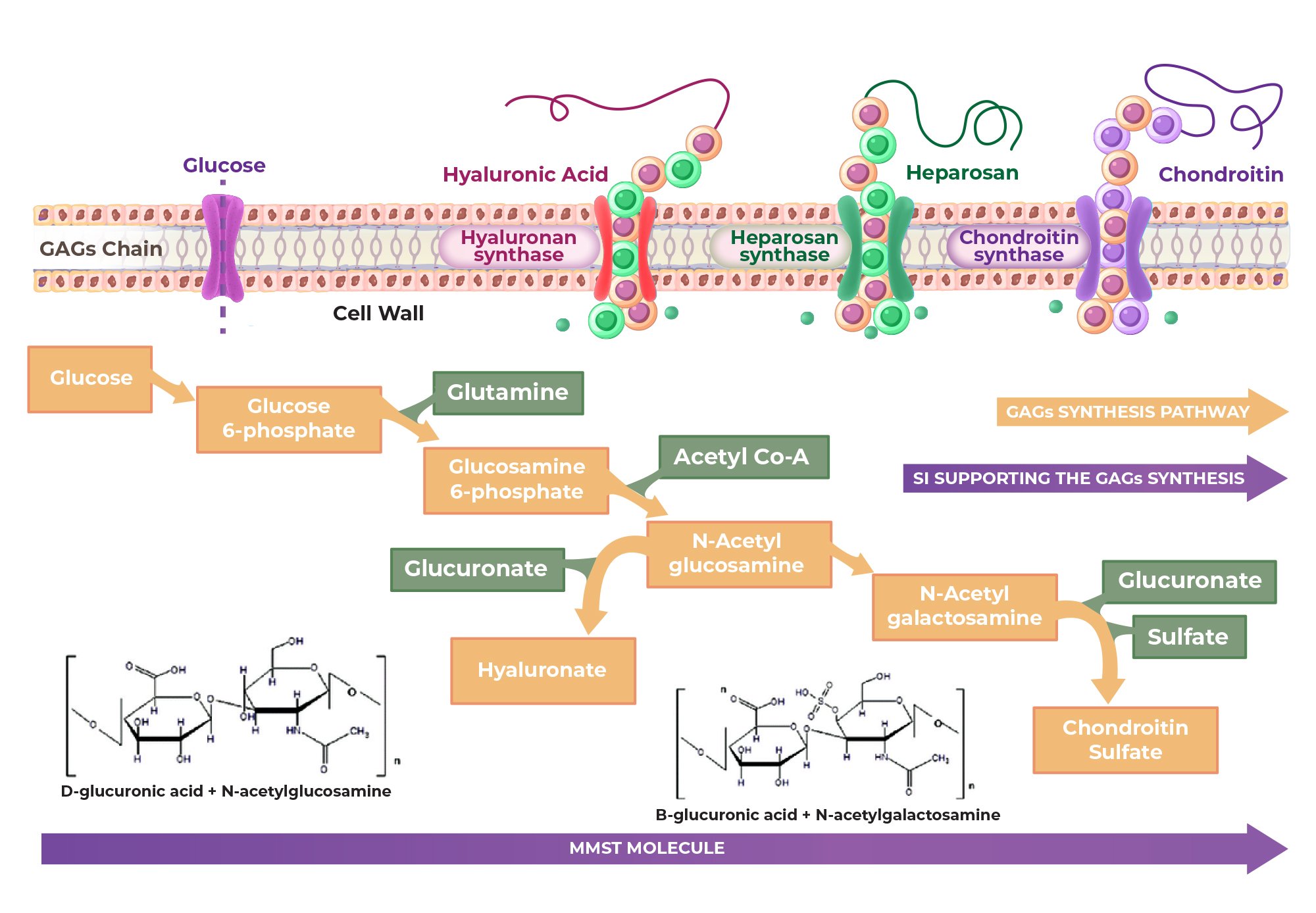 Figure 1.
Biosynthetic pathway of glycosaminoglycans. Chondroitin Sulfate, Glucosamine Sulfate, and Hyaluronic Acid are the precursors of Cartilage Matrix.
Figure 1.
Biosynthetic pathway of glycosaminoglycans. Chondroitin Sulfate, Glucosamine Sulfate, and Hyaluronic Acid are the precursors of Cartilage Matrix.
C) Connective Tissue and Vascular Integrity
Beyond joints, silicon is also associated with structural proteins such as elastin.
This is relevant for:
- Maintenance of tissue elasticity
- Structural integrity of vascular and connective systems
- Support of extracellular matrix organization
These properties extend the applicability of silicon into broader connective tissue and healthy aging formulations.
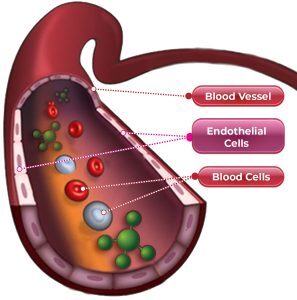 Figure 2.
Silica interacts with endothelial cells along blood vessels, from the aorta to microvessels, forming a selective blood-tissue barrier.
Figure 2.
Silica interacts with endothelial cells along blood vessels, from the aorta to microvessels, forming a selective blood-tissue barrier.
D) Tendons, Ligaments, and Structural Resilience
Tendons and ligaments are highly dependent on collagen organization and mechanical strength.
Bioavailable silicon is associated with:
- Support of collagen-related pathways
- Maintenance of tissue flexibility and resistance
- Structural integrity under repetitive stress
This makes it relevant in formulations targeting active lifestyles and physical resilience.
Formulation Relevance of Bioavailable Silicon
The effectiveness of silicon in nutraceutical applications depends on its chemical form.
LIVING SILICA® incorporates stabilized monomethylsilanetriol (MMST), designed to:
- Remain soluble and bioavailable
- Avoid polymerization into inactive forms
- Support consistent absorption profiles
In addition, acacia gum-based systems can contribute to formulation stability and compatibility.
Positioning Opportunities for Joint Health Products
LIVING SILICA® enables brands to develop differentiated formulations by:
- Complementing traditional joint ingredients (e.g., glucosamine, chondroitin)
- Supporting collagen-related positioning
- Expanding into multi-tissue support concepts (joints, skin, bone, connective tissue)
- Aligning with vegan and clean-label trends
This allows for the development of next-generation joint health products beyond conventional approaches.
Scientific Context
Research on silicon has explored its relationship with connective tissue and bone metabolism.
Published studies suggest associations with:
- Collagen structure and extracellular matrix organization
- Bone mineralization processes
- Connective tissue integrity
While ongoing research continues to refine these mechanisms, current evidence supports the use of bioavailable silicon forms in structurally focused formulations.
Supporting Advanced Joint Health Formulations
As the joint health category evolves, there is increasing focus on structural support, tissue resilience, and long-term mobility.
Bioavailable silicon offers a complementary approach that supports these objectives, enabling more comprehensive and differentiated product strategies.
Technical Documentation and Formulation Support
For specifications, scientific documentation, or formulation guidance:
- +1 (305) 779-0171 | (877) 454 2486
- lab@orgonolivingsilica.com
Or fill out our contact form to connect with our team:
get more information
about our ingredients
LEARN MORE ABOUT
SILICA